
There is no such thing as passive listening
so lets just scrap the term, shall we?

Three years ago, when I just started learning Finnish, I jumped into listening right away. Almost right away. I got through 1.5 units of a Duolingo course (got bored), skimmed through a grammar website (useful even if somewhat horrifying), and felt ready.
I found an app called Radio Garden that lets you roam the globe listening to live radio stations in different countries, and zoomed in on Finland. I spent some time searching for local radio stations that didn’t just play music all the time (it wasn’t easy) and picked two or three favorites.
It sounds like a good idea in principle — and Radio Garden is amazing, it’s like Google Earth for radio — but it didn’t work in practice.
There was obviously no transcript, no translation, and no subtitles, which is a problem if you’re a beginner with zero listening experience, who can’t even recognize the boundaries between words.
I’d be sitting there (or walking) and listening very intently, and every 90 seconds I’d hear a familiar word (jalkapallo ‘football’ - it’s a sports show!!!) and do a little happy dance.
Luckily, it took me only two days to understand that I was wasting my time. That I was taxing my brain and not getting much out of it. That whatever I could learn from it, I already did, which is: that people all over the world prefer to listen to Elton John on the radio.
Useless listening. That’s what it was. That’s the term I wish existed in language learning spaces, instead of the terms people use: ‘passive’ listening vs ‘active listening’.
Because, honestly, the term ‘passive listening’ is either misleading or actively harmful.
What is ‘passive’ listening?
I’m not sure exactly what people mean when they say ‘passive’ listening. Listening to content while doing something else? But there is nothing passive about it, or there shouldn’t be.
That’s exactly the problem.
Some people say that ‘passive listening’ is just playing content in your target language in the background while doing other things and hoping your brain will just absorb it. Because, the reasoning goes, this is how babies acquire language, by being constantly exposed to it.
The problem is that your mind is different from a baby’s. It’s the baby’s job to absorb everything going around her because she needs to learn how to survive in this world.
Your mind has already learned how to survive very well without spoken Vietnamese. In fact, it has learned to effectively filter out things that are not necessary for survival, and spoken Vietnamese belongs in that category.
(By the way, just because that baby is not taking any notes while listening, doesn’t mean she’s doing passive listening.)
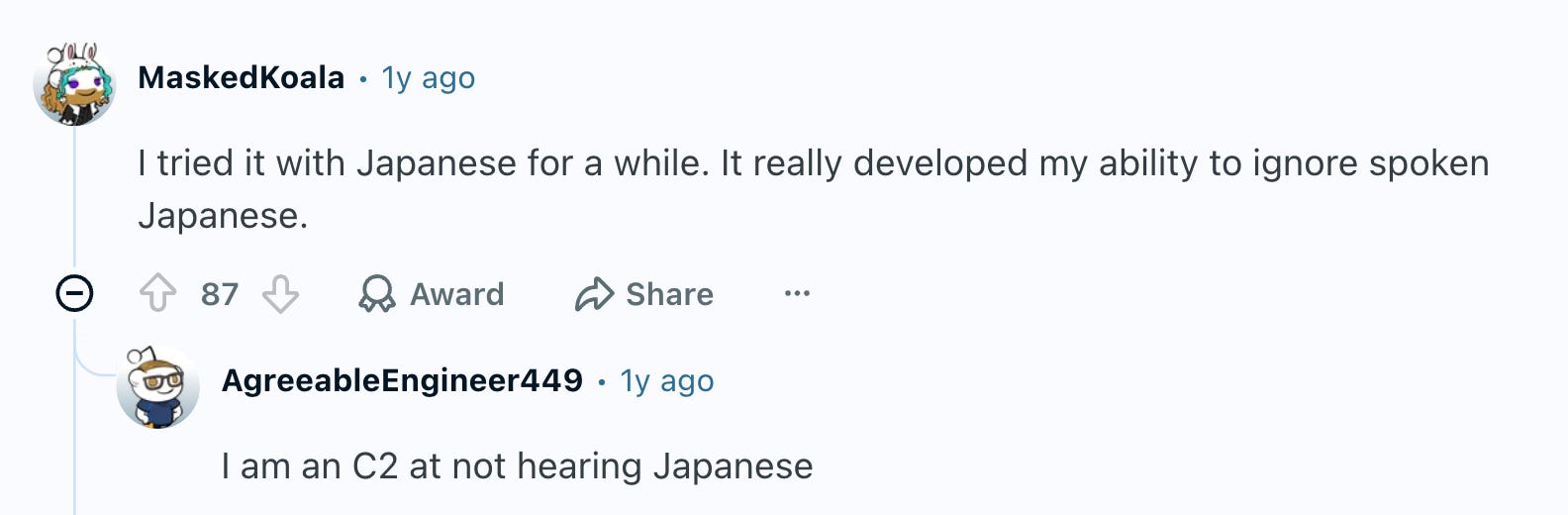
Some people would say that my Radio Garden session counted as the 'passive' kind. But it didn't feel passive. It felt like my brain working super hard and getting almost nothing out of it.
What useful listening looks like
I still like to listen a lot, and I do the vast majority of my listening while doing something else, because I’m a single mom and my time is limited.
When I was learning language after language for a year, like a madwoman, 80% of that learning was done by listening while going about my daily life.
Even now, with Arabic, sometimes this is the only sort of listening I do for days.
But whether I listen while multitasking, or sit down for a super intense listening session there is nothing ‘passive’ about it. I’m always actively listening, at the very least trying to understand the gist of what is being said.
And I’ve learned to choose my listening content more wisely. For Finnish, after Radio Garden, I quickly switched to Peppa Pig (Pipsa Possu). It has subtitles (helpful), plus — cartoon characters tend to speak more clearly than sports commentators on the radio.
With Arabic now, I can listen to grown up shows without subtitles, because most of the time I can at least reliably parse where one word ends and the next begins.
Occasionally, if I’m tired, I might listen to stuff I’ve listened to earlier and already understand very well. This is as ‘passive’ as it gets.
There is really no such thing as passive listening or active listening. There is just useless and useful listening.
I don’t know if there’s a magic threshold for how much you need to understand for it to be useful (70%? 43%?) - it’s hard to say. But I think if you can get the gist of the story, if you recognize the boundaries between words, if you feel like you’re enjoying yourself because you’re getting at least a little bit of the story (and not just one stray word every 90 seconds) — then I’d count it as useful.
‘Useless’ listening is worse than nothing
Listening to content and managing to understand only one word every 90 seconds = useless listening.
Listening to content in the background and not trying to understand it = also useless listening.
Some people say that even these kinds of listening are better than nothing. I disagree. They’re worse than nothing. Why?
The second kind teaches you to filter out the language you’re trying to learn.
The first kind uses valuable brain energy without giving you much in return.
You’re much better off listening to some relaxing music, or nothing, and then coming to your actual, useful listening session freshly rested.
So if you’ve been half-heartedly playing French radio on your tired drive home from work (and wondering why it’s not improving your French), I hereby give you the official permission to switch stations and listen to some Elton John.
If you’re a writer on Substack, consider recommending The Language Obsessive to your readers. I write about language learning from the inside. (Go to Dashboard > Recommendations to add a recommendation)
Great advice as always
In my opinion, active listening is more helpful than passive listening. However, I don't think passive listening is totally useless, because it's for when you just want to hear sth and don't want to analyse it linguistically.